Learn how to choose a high-speed single-pass digital plastic cup printer in 2026. Compare UV printing technology, speed, white ink, cup compatibility and CUP-1UV vs CUP-2UV.
Choosing a single-pass digital plastic cup printer is not simply a matter of selecting the machine with the highest advertised speed.
For commercial plastic cup printing, the right machine needs to match the cup material, cup shape, printing coverage, color requirements, production volume, artwork changes, and required automation.
For businesses looking for high-speed digital printing on plastic cups, UV single-pass technology provides a digital alternative to traditional plate-based printing. It can support full-color artwork, fast design changes and short-to-medium production runs without conventional printing plates.
Caspijet offers two dedicated models for this application:
- Caspijet CUP-1UV — Single-Side UV Digital Plastic Cup Printer
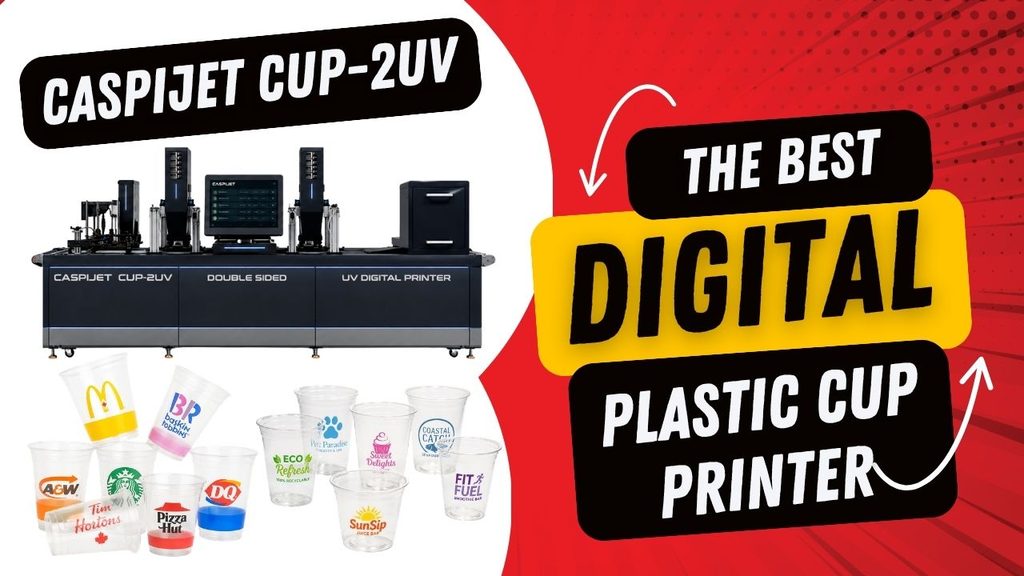
- Caspijet CUP-2UV — Double-Sided UV Digital Plastic Cup Printer
The main difference is straightforward: CUP-1UV is designed for single-side cup printing, while CUP-2UV is designed for double-sided printing in one production workflow.
Quick Answer: Which Plastic Cup Printer Should You Choose?
If you need a single-side UV digital plastic cup printer, the Caspijet CUP-1UV is the relevant configuration.
If you need double-sided plastic cup printing, the Caspijet CUP-2UV is the relevant configuration.
Both machines belong to the same Caspijet digital UV cup-printing family, but they address different production requirements.
| Requirement | CUP-1UV | CUP-2UV |
|---|---|---|
| UV digital printing | ✓ | ✓ |
| Digital plastic cup printing | ✓ | ✓ |
| Single-side printing | ✓ | ✓ |
| Double-sided printing | — | ✓ |
| Full-color CMYK printing | ✓ | ✓ |
| White UV ink configuration | ✓ | ✓ |
| Plate-free digital workflow | ✓ | ✓ |
| Suitable for customized artwork | ✓ | ✓ |
| Best suited to | Single-side decoration | Double-sided decoration |
Important: Actual printability, adhesion and final appearance should always be confirmed using the customer’s specific cup material and production samples.
What Is a Single-Pass Digital Plastic Cup Printer?
A single-pass digital plastic cup printer is a digital inkjet printing system designed to print onto cups or other suitable objects in a single printing pass rather than moving the printhead repeatedly across the same print area.
In UV digital printing, UV-curable ink is deposited onto the printable surface and cured as part of the printing process.
The basic workflow is:
Cup loading → positioning → digital inkjet printing → UV curing → finished printed cup
Unlike conventional screen or offset processes, digital printing does not require a separate printing plate for each artwork.
This makes digital cup printing particularly useful when a business needs to handle:
- Multiple designs
- Short production runs
- Frequent artwork changes
- Customized cups
- Seasonal designs
- Promotional campaigns
- Multiple customer orders
- Variable graphics
Why Are Businesses Moving Toward Digital Plastic Cup Printing?
Traditional plastic cup decoration processes can be highly productive for long repeat orders, but they can involve significant preparation when artwork changes.
Digital printing changes the production workflow.
Instead of preparing a new physical printing plate for every new design, the artwork can be sent digitally to the printer.
This can make digital printing particularly attractive for businesses producing multiple SKUs or shorter production runs.
Key advantages of digital plastic cup printing include:
1. No conventional printing plates
Digital artwork is sent directly to the printing system.
2. Faster artwork changes
Changing from one design to another can be handled through the digital workflow rather than replacing conventional printing plates.
3. Full-color graphics
CMYK digital printing can reproduce photographs, gradients, illustrations and other complex artwork.
4. Short-run flexibility
Digital printing can be useful when production involves many designs rather than one extremely long repeat run.
5. Customization
Different artwork can be produced for different customers, campaigns or product variants.
6. Digital production workflow
Artwork preparation, RIP processing, printing and curing can be integrated into a digital production process.
What Should You Look for in a High-Speed Plastic Cup Printing Machine?
When comparing a high-speed plastic cup printer, don’t evaluate speed alone.
Consider at least these eight factors.
1. Printing Technology
First determine whether the machine is:
- UV digital
- Screen printing
- Offset/dry-offset
- Pad printing
- Transfer-based
- Another digital decoration technology
For businesses that require frequent artwork changes and full-color digital graphics, UV digital printing is an important technology to evaluate.
The correct technology ultimately depends on the cup material, artwork, production volume and required finish.
2. Single-Side or Double-Sided Printing?
This is one of the most important questions.
A business printing only one visible design area does not necessarily need the same machine configuration as a business requiring artwork on both sides of the cup.
CUP-1UV — Single-Side UV Digital Cup Printer
The Caspijet CUP-1UV is designed for businesses that primarily need single-side digital printing on cups.
It is appropriate to consider when the production requirement is:
- One main printed side
- Full-color digital artwork
- Frequent artwork changes
- Customized cup production
- Short or variable production runs
- UV digital printing
CUP-1UV video demonstration:
Product page:
Caspijet CUP-1UV
3. CUP-2UV — Double-Sided UV Digital Cup Printer
The Caspijet CUP-2UV is designed for applications requiring double-sided cup printing.
This is particularly relevant when a cup needs different or coordinated graphics on opposite sides.
Potential applications include:
- Brand graphics on two sides
- Promotional cups
- Event cups
- Beverage packaging
- Customized disposable cups
- Multi-design cup decoration
The major reason to consider CUP-2UV is therefore not simply speed. It is the ability to address a two-sided printing requirement within the machine’s intended production workflow.
CUP-2UV video demonstration:
Product page:
Caspijet CUP-2UV
4. Does the Printer Support White UV Ink?
White ink is particularly important when printing on:
- Transparent cups
- Dark-colored cups
- Colored plastic
- Substrates where the artwork requires an opaque white layer
Without an appropriate white layer, CMYK colors can appear different from the intended artwork when printed directly onto dark or transparent substrates.
For this reason, when comparing a UV plastic cup printer, ask:
- Does it support white ink?
- How is white ink handled?
- Is circulation provided?
- Can white be used as an underbase?
- Can the machine print CMYK + White?
- Has the exact cup material been tested?
Caspijet’s CUP-1UV and CUP-2UV configurations are designed around UV digital cup printing with CMYK and white capabilities.
5. Cup Material Compatibility
Never assume that every plastic cup will behave identically.
Plastic cups can be manufactured from different materials, including:
- PP
- PET
- PE
- Other plastic formulations
Surface characteristics can vary even within the same general material category.
Therefore, when selecting a digital plastic cup printing machine, the correct procedure is to test the actual cup.
Evaluate:
Ink adhesion
Does the UV ink adhere adequately to the cup?
Color
Does the printed color match the required appearance?
Coverage
Does the machine provide the required print area?
Curing
Does the UV curing system produce the required result?
Durability
Does the finished print withstand the intended handling and use?
A machine’s ability to physically print on a sample does not by itself prove that the complete production process is suitable.
6. Cup Shape and Dimensions
Plastic cups are not always simple cylinders.
They may be:
- Straight-sided
- Tapered
- Conical
- Slightly curved
- Different in diameter
- Different in wall thickness
The cup geometry affects:
- Print positioning
- Printhead clearance
- Artwork distortion
- Registration
- Print coverage
- Mechanical handling
Therefore, before buying a high-speed plastic cup printing machine, provide the manufacturer with your actual cup dimensions.
Useful information includes:
- Cup diameter
- Cup height
- Taper angle
- Printable area
- Material
- Cup wall characteristics
- Required print position
7. Production Speed
Speed is one of the most important specifications for a commercial high-speed cup printing machine, but it should not be considered in isolation.
A machine advertised at a certain maximum speed may produce different output depending on:
- Print mode
- Artwork coverage
- Number of colors
- White ink requirements
- Cup size
- Printing area
- Loading method
- Machine configuration
Therefore, ask the manufacturer to demonstrate the machine using your actual cup and artwork.
Ask for a production test
Instead of asking only:
“What is the maximum speed?”
ask:
“How many of my cups can the machine produce per hour with my actual artwork and required print quality?”
That is a much more useful production question.
8. Automation and Cup Handling
A high-speed digital cup printer needs more than a good printhead.
The complete production system matters.
Consider:
- Cup loading
- Positioning
- Transport
- Registration
- Printing
- UV curing
- Unloading
- Operator involvement
As production volume increases, mechanical consistency becomes increasingly important.
Single-Pass vs Multi-Pass Cup Printing
One of the key terms buyers encounter is single-pass printing.
In a conventional multi-pass inkjet system, the printhead repeatedly moves across the printing area.
In a single-pass system, the printing architecture is designed so that the product passes through the printing zone while the inkjet system performs the required printing operation in a single pass.
This architecture can be advantageous for industrial production because it is designed around continuous product movement rather than repeated scanning.
However, buyers should compare the complete production cycle, not just the words “single pass.”
Consider:
Loading + positioning + printing + curing + unloading = actual production cycle
This is particularly important when comparing different manufacturers.
Single-Pass Digital Printing vs Traditional Plastic Cup Printing
| Factor | Digital UV Printing | Traditional Plate-Based Printing |
|---|---|---|
| Printing plates | Not required for digital artwork | Usually required |
| Artwork changes | Fast digital changeover | Additional preparation may be required |
| Short runs | Flexible | Depends on setup |
| Multiple designs | Flexible | More preparation |
| Full-color artwork | Suitable for complex digital graphics | Depends on process |
| Personalization | Possible with digital workflow | More limited |
| Long repeat runs | Depends on economics | Often strong |
| Setup workflow | Digital | Plate/tooling based |
The right choice depends on the production profile. Traditional printing technologies can remain appropriate for long, stable, high-volume repeat orders, while digital UV printing can be attractive when flexibility and artwork variation are important.
CUP-1UV vs CUP-2UV: Which Configuration Fits Your Production?
Rather than asking which machine is universally “best,” start with the required printing configuration.
Choose CUP-1UV when:
- You primarily need single-side printing
- Your customers require full-color digital graphics
- You need frequent artwork changes
- You want a digital UV cup printing workflow
- You don’t require dedicated double-sided printing
Consider CUP-2UV when:
- You require double-sided printing
- Both sides of the cup need graphics
- You produce promotional or branded cups
- You want a digital workflow for two-sided cup decoration
- Double-sided production is an important part of your business
This distinction is more useful than simply comparing headline machine speeds.
What Can You Print With a Digital Plastic Cup Printer?
A UV digital cup printing machine can be considered for applications such as:
Beverage Cups
- Disposable plastic drinking cups
- Coffee cups
- Cold beverage cups
- Juice cups
- Promotional beverage cups
Promotional Cups
- Event cups
- Marketing campaigns
- Corporate promotional products
- Customized cups
Brand and Packaging Applications
- Brand graphics
- Product graphics
- Promotional artwork
- Seasonal designs
- Multiple-SKU packaging
The exact application depends on the cup material, shape, printable surface and required durability.
Why UV Digital Printing Is Attractive for Custom Plastic Cups
One of the biggest advantages of digital printing is production flexibility.
Imagine a customer needs:
- 500 cups with Design A
- 500 cups with Design B
- 500 cups with Design C
- 500 cups with Design D
A digital workflow can make changing between digital artwork files much simpler than a conventional plate-based workflow.
This makes digital plastic cup printing particularly relevant to businesses serving multiple brands, events, campaigns and customized orders.
How Much Does a Plastic Cup Printing Machine Cost?
The price of a plastic cup printing machine depends heavily on the printing technology and production configuration.
When comparing quotations, don’t compare the machine price alone.
Check whether the quotation includes:
- Printheads
- UV curing system
- Ink system
- White ink system
- Software/RIP
- Cup fixtures
- Automation
- Installation
- Training
- Warranty
- Spare parts
- Technical support
Two machines with similar headline specifications can have very different total costs of ownership.
For a serious production purchase, request a complete quotation and a sample test using your actual cups.
What Should You Ask a Plastic Cup Printer Manufacturer?
Before purchasing a high-speed digital plastic cup printer, ask the manufacturer these questions:
About the cup
- What plastic materials can the machine print?
- What cup diameters are supported?
- Can it print tapered cups?
- What is the maximum printable area?
- Can you test my actual cup?
About printing
- Does the machine use UV-curable ink?
- Is white ink available?
- What CMYK configuration is supported?
- What is the actual production speed?
- What print quality is achieved at production speed?
About production
- Is the machine single-pass?
- How are cups positioned?
- How much operator intervention is required?
- Can the machine handle multiple designs?
- Can it print both sides?
About ownership
- What are the recommended consumables?
- What are the printhead maintenance requirements?
- What spare parts should be kept?
- What warranty is provided?
- What technical support is available?
Why Sample Testing Is Essential
Before purchasing any UV digital cup printer, test your actual production material.
Send the manufacturer:
- Your actual cups
- Your artwork
- Required colors
- Required print area
- Expected production volume
- End-use requirements
Then evaluate:
Print quality → adhesion → color → coverage → curing → repeatability → production speed
This is much more meaningful than choosing a machine based solely on a specification sheet.
Caspijet CUP-1UV and CUP-2UV
Caspijet’s plastic cup printing range is designed around digital UV printing for customers looking to move from conventional plate-based decoration toward a more flexible digital production workflow.
Caspijet CUP-1UV
Single-Side UV Digital Plastic Cup Printer
The CUP-1UV is the configuration to evaluate when your primary requirement is single-side digital plastic cup printing.
Caspijet CUP-2UV
Double-Sided UV Digital Plastic Cup Printer
The CUP-2UV is designed for businesses requiring double-sided UV digital cup printing.
Frequently Asked Questions
What is a single-pass digital plastic cup printer?
A single-pass digital plastic cup printer is a digital inkjet system designed to print onto suitable plastic cups during a single printing pass. UV-curable ink is used in UV configurations and cured as part of the printing process.
What is the difference between CUP-1UV and CUP-2UV?
The primary distinction is the printing configuration. CUP-1UV is designed for single-side UV digital cup printing, while CUP-2UV is designed for double-sided UV digital cup printing.
Can UV digital printers print on plastic cups?
Yes, UV digital printing can be used for suitable plastic cups, but compatibility depends on the actual plastic formulation, surface characteristics, ink system and required end-use performance. Testing the customer’s actual cups is recommended.
Can a digital cup printer use white ink?
UV digital cup printers can be configured for white ink. White can be particularly important when printing on transparent or dark substrates.
Is digital plastic cup printing plate-free?
Digital printing does not require conventional printing plates for each new artwork. The artwork is processed digitally and sent to the printer.
Is single-pass printing faster than multi-pass printing?
Single-pass architecture is designed for high-speed production because the product passes through the printing zone once. However, actual production output depends on the machine configuration, cup size, print area, artwork, print mode and handling system.
Can CUP-2UV print both sides of a plastic cup?
CUP-2UV is Caspijet’s double-sided UV digital plastic cup printing model and is designed for two-sided cup printing applications.
What plastic cups can I print?
Compatibility depends on the specific cup material and surface. PP, PET and other plastic substrates should be tested using the exact cup intended for production.
Should I choose a cup printer based only on maximum speed?
No. Production speed should be evaluated together with print quality, cup compatibility, printing coverage, curing, loading, unloading and actual production cycle time.
Is a digital plastic cup printer suitable for short runs?
Digital printing can be particularly useful for variable artwork, multiple SKUs and short-to-medium production runs because new designs can be processed digitally without preparing a new conventional printing plate.
Final Checklist: Choosing a High-Speed Digital Plastic Cup Printer in 2026
Before purchasing a single-pass digital plastic cup printing machine, make sure you have confirmed:
☑ Cup material
☑ Cup diameter and height
☑ Cup shape and taper
☑ Required print area
☑ Single-side or double-sided printing
☑ CMYK requirements
☑ White ink requirements
☑ Actual production speed
☑ UV curing performance
☑ Ink adhesion
☑ Print quality
☑ Multiple-design workflow
☑ Operator requirements
☑ Maintenance requirements
☑ Spare parts
☑ Warranty
☑ Technical support
☑ Sample testing using your actual cups
The right high-speed plastic cup printer is ultimately the machine that matches your actual cups and production requirements—not simply the machine with the largest speed number in a specification sheet.
For single-side digital cup printing, evaluate Caspijet CUP-1UV. For double-sided digital cup printing, evaluate Caspijet CUP-2UV.
Caspijet CUP-1UV — Single-Side UV Digital Plastic Cup Printer
Caspijet CUP-2UV — Double-Sided UV Digital Plastic Cup Printer